- By
- RV World UAE
- Published
- 9 min read
The Gulf Breaks RVs Differently
A European maintenance schedule assumes a vehicle that winters under a cover in damp cold and comes out for a mild summer. Nothing about that describes a motorhome in the UAE.
Here the enemy is ultraviolet, heat and time — and the systems that fail first are not the ones on the service sheet. Sealant hardens. Rubber perishes. Tyres age out years before the tread wears. Batteries cook. Air conditioners that coped fine in Munich give up in Sharjah in June.
Almost all of it is preventable, and the preventive work is cheap compared to what it prevents.
The Roof: The Most Important Job Nobody Does
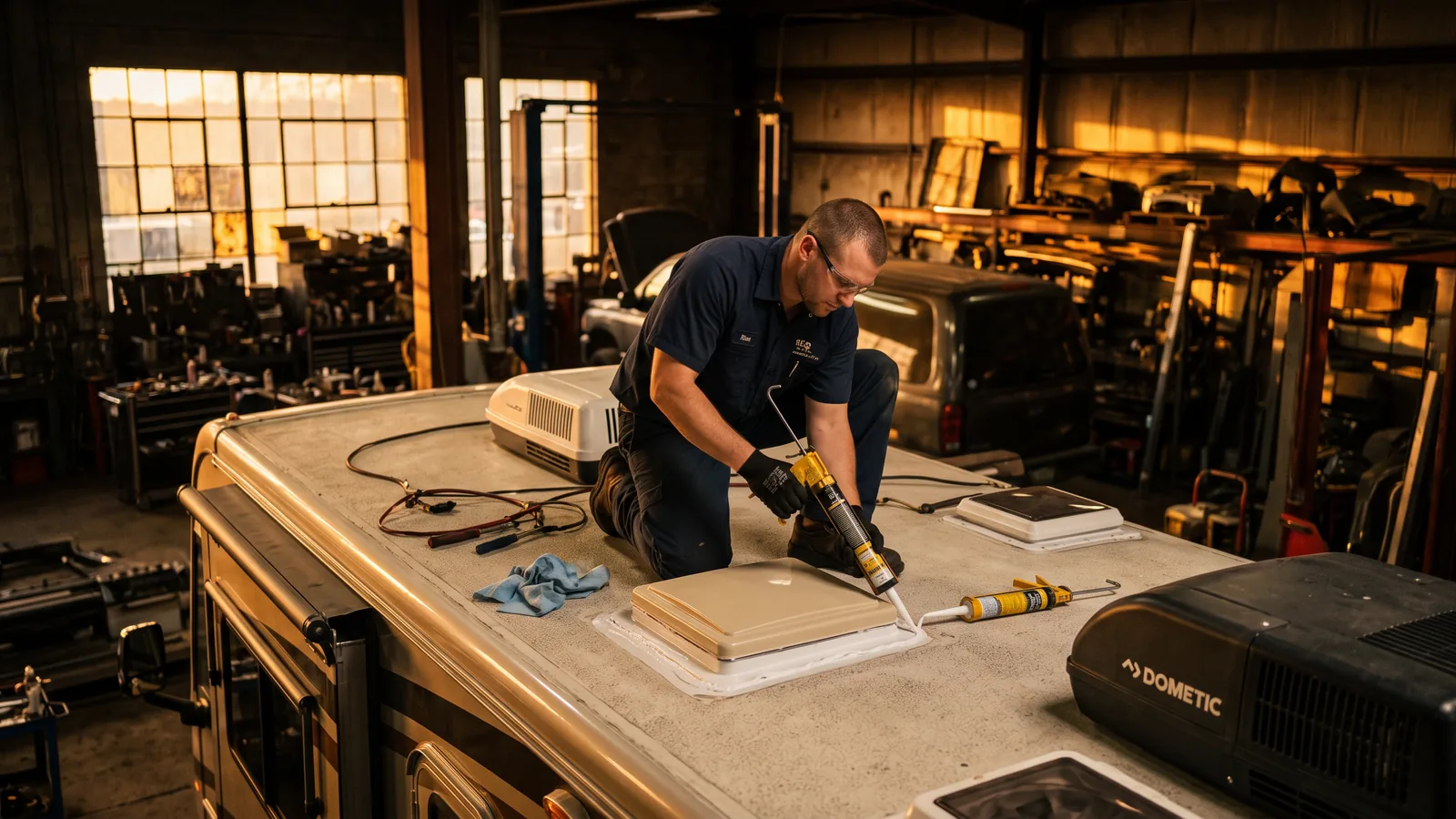
Inspect the roof every three months. This is the highest-value maintenance task on a UAE motorhome.
Every seam, vent, skylight, aerial and solar-panel mount is sealed with a compound that UV attacks continuously. Sealant rated for years of European weather can harden and craze here in a fraction of that time. Once it cracks, water gets in — not necessarily from rain, but from wash-downs, condensation and the genuinely wet weeks the UAE does get.
Water in a bonded sandwich wall or a plywood floor delaminates the structure from the inside. By the time a stain appears on the ceiling, the repair is major — a tube of sealant and an hour on a ladder is not.
Get up there with a torch. Look for cracking, lifting edges, chalking and any gap a fingernail fits into. Reseal early rather than perfectly.
Tyres: Age, Not Tread
Check the DOT date code on every tyre, including the spare.
This one contradicts normal car intuition. Motorhome tyres almost never wear out — the vehicle does not cover the mileage. They age out. UV and sustained heat break the rubber down from the outside, and a tyre with 8 mm of tread and six years of Gulf sun carries a real failure risk at highway speed under three tonnes.
The date code is a four-digit stamp on the sidewall: week and year. Read it, then follow the tyre and vehicle manufacturers' guidance on service life and have the tyres professionally assessed as they age — do not rely on a number you read online.
Also check pressures cold, every trip, against the plate for your loaded weight — not the number on the tyre. If you deflate to around 15–18 psi for sand, reinflate fully before returning to tarmac; highway speed on a deflated motorhome tyre builds heat fast and ends badly.
Air Conditioning: Service It in September
Do not discover your AC is weak in June. Service it at the end of summer, before the workshop fills with people who left it too late.
- Clean or replace the filters — a clogged filter costs you cooling and works the compressor for nothing.
- Have the gas pressure checked properly. A slow leak is invisible until the day it matters.
- Clean the condenser coils. Dust and sand accumulate constantly here and strangle efficiency.
- Check the roof unit's mounting seal while you are up there — a classic water entry point.
- Measure the output temperature. A unit only just coping in March will not cope in June.
Batteries and Solar
Heat is hard on batteries. Lead-acid chemistry degrades measurably faster at high ambient temperatures, and a bank that would last years in a European garage will not do the same here.
- Check terminals for corrosion and clean them. Trivial, and it fixes a surprising share of "electrical faults".
- Test under load, not at rest. A resting voltage reading tells you almost nothing.
- Never leave batteries deeply discharged in storage. In this heat, that is how a bank dies permanently rather than temporarily.
- Clean the solar panels. Dust accumulation here is constant and costs real output. Rinse them monthly in season.
The Generator
Generators fail from disuse, not overuse. Fuel goes stale, carburettors gum up, and the unit that started perfectly in April refuses in November.
- Run it under actual load for around half an hour monthly. Idle does not clear anything.
- Change oil and filters at the manufacturer's interval based on hours run, not calendar months.
- A CO alarm is not optional if you have a generator. Test it, and replace it at the manufacturer's stated interval.
Water Systems
- Sanitise the fresh tank at the start of every season. Warm water plus a tank that sat for months equals bacteria. This is a health issue, not a housekeeping one.
- Check every joint and the pump for weeping — a slow leak inside a cabinet does the same damage as a roof leak, more quietly.
- Empty and flush grey and black tanks at proper facilities. In this heat, a tank left with contents becomes an unforgettable problem within days.
Storage Through Summer
Most owners park up from roughly June to September. Do it properly:
- Shade or a breathable cover. Four months of direct summer sun does years of damage to seals, vinyl, awning fabric and dashboards — the cheapest single thing you can do for resale value.
- Fuel stabiliser in the tank, batteries on a maintainer, water system drained.
- Tyres at full pressure, and move the vehicle occasionally if you can — flat spots are real.
- Ventilation, or something to control humidity inside. A sealed box in Gulf summer grows mould.
None of this is difficult. All of it is cheaper than the repair it prevents — usually by an order of magnitude.
Tags
- Maintenance
- Ownership
- Workshop
Ready to hit the road?
Message us on WhatsApp and we will tell you exactly what your trip needs.